
Corporate Training for High-Performing Teams
Build a psychologically safe culture, so teams collaborate and innovate
training
Why Most Corporate Training Programs Fail
The effects of corporate training programs often do not last beyond 72 hours.
Managers return with new frameworks.
Teams return to the same dynamics.
The issue is not leadership capability. It's team behavior and workplace communication.
Teams struggle to:
1. Communicate across roles
2. Navigate differences
3. Build trust under pressure
Most employee training programs focus on knowledge.
Effective corporate training focuses on behavior and execution.
These corporate training programs focus on how teams perform in real-world conditions.
Why you need to build teams in your corporate training

Invest in Teams Collaboration with Intention and Strategy
Chuen Chuen Yeo's doctoral research at École des Ponts Business School focuses on fear of failure and organisational innovation. What she has found across 3,000 hours of coaching leaders from nearly 40 countries is consistent.
Organisations invest heavily in making leaders better.
But they invest almost nothing in making teams work.
The gap is not accidental. In many Asian organisational cultures, leaders are trained to direct and instruct. Bottom-up communication, the kind that surfaces ideas, invites disagreement, and builds shared accountability, is rarely modeled. The result is organisations where the formal culture says "speak up" and the lived experience is silence.
Innovation does not fail because leaders lack strategy. It fails because the team conditions for innovation were never built. Trust. Psychological safety. The ability to work across differences. These are not soft skills. They are the infrastructure that everything else runs on.
These programmes are built to close that gap.
TRUSTED BY





















corporate training
What Changes in your Teams
Most teams don't have a talent problem. They have a communication and culture problem. Our training gives your people the tools to work better together, not just during the program, but long after it ends.
Team members understand what each person brings and how to work with, not around, their differences
Communication across roles, generations, and cultures become a strength rather than a source of friction
Leaders have concrete skills to build trust as a daily practice, not a concept
Teams stop performing individually and start performing together
corporate training for teams
Three Programmes to Make Your Teamwork Work
CliftonStrengths® for Teams
Most CliftonStrengths programmes stop at the individual report. Everyone learns their top five, goes back to work, and nothing changes.
We go further. We map how your team's strengths combine, what's missing, and where the friction is really coming from. The results speak for themselves: strengths-focused teams are 12.5% more productive, 8.9% more profitable, and seven in ten employees whose manager focuses on their strengths are fully engaged.
Best for teams with recurring friction, newly restructured groups, and leaders managing across generations and cultures.

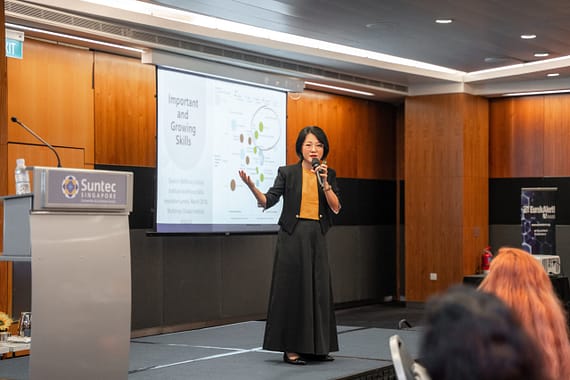
Leadership Storytelling for Teams
Change fails when leaders announce it instead of telling it. An announcement gives information. A story gives people a reason to care.
This isn't about presentation skills or stage presence. It's built around empathy, understanding what your audience needs to hear, shaped by what actually happened. It works especially well for introverted leaders and spans generational and cultural differences.
Best for leaders driving change and organisations where internal communication has gone cold.
Trust and Psychological Safety for High-Performing Teams
Eight specific behaviours that quietly erode trust, inconsistency, conflict avoidance, micromanagement, taking credit, breaches of confidentiality, are named and examined through your own team context. Grounded in Lencioni and Edmondson's research, participants work through real scenarios using the Trust Triangle: Authenticity, Logic, Empathy, and leave with specific behaviours they commit to changing, not just aspirations.
Best for teams where conflict is avoided rather than resolved, and organisations where trust needs deliberate repair.

Custom Corporate Training
Solutions That Develop Leadership, Communication, and Team Performance
Every programme is built around your organisation. Before anything runs, we understand your team structure, your leadership challenges, and the outcomes you actually need. We partner with you to select the best content that suits your context. That is the difference between training people remember and training that disappears by Monday.
Communication that works across roles, generations, and cultures. Trust that holds under pressure. The conditions where people do their best work and where innovation has room to grow.
Ready to Build Teams that Actually Collaborate?
Tell us about your organisation and the employee training program you have in mind.
Faq.
Not the right people or the right process. The key is building conditions where people feel safe enough to contribute fully, to share ideas, challenge assumptions, and flag problems without fear. That environment does not emerge naturally. It is built through specific leader behaviours and team practices, including the digital skills and technical skills that support how modern teams communicate and collaborate. That is what corporate training courses are designed to do.
Done well, the impact is measurable. Teams focusing on strengths have 12.5% greater productivity. High-trust environments link directly to innovation performance. The caveat is "done well." Generic activities like icebreakers, off-sites, and one-day training sessions rarely change anything because they do not address the specific dynamics breaking trust in that particular team. Programmes that name the real behaviours, refresh essential skills, create shared language, and hold people to specific commitments produce different results.
Leadership training alone changes the individual. Team dynamics work changes the environment they return to. Leaders who go through individual training often revert because the team around them has not changed. When the team-level work happens, the norms shift. The language shifts. The expectations people hold of each other shift. When change lasts beyond 72 hours, that's when you know you have the best corporate training provider for your organisation.
Only when they address the real communication failures, which are rarely about clarity or presentation. The actual breakdowns happen across different generational, cultural, and hierarchical groups. A leader who cannot tell a story that lands for someone 20 years younger or from a different background will struggle to build alignment, regardless of how clearly they speak. The Leadership Storytelling programme closes that specific gap. Most communication training does not go near it.
Any team where the individuals are capable but the collective is underperforming. The organisations that see the greatest return are those going through structural change [ new leadership, restructuring, rapid growth ], where old team dynamics no longer fit the new context. Also, teams with significant generational or cultural diversity have not yet become a strength. And organisations where innovation is a stated priority, but the team environment does not yet support the risk-taking innovation requires. This includes teams looking to develop key skills for collaboration, because high performance depends on both.