

Last Updated on June 5, 2026 by YEO Chuen Chuen
Leading a global workforce requires six core leadership skills: a continuous learning mindset, leveraging technology, building async trust, promoting work-life balance, managing with empathy, and maintaining visibility to eliminate proximity bias. Together, these help leaders connect remote and on-site teams, sustain performance, and protect well-being
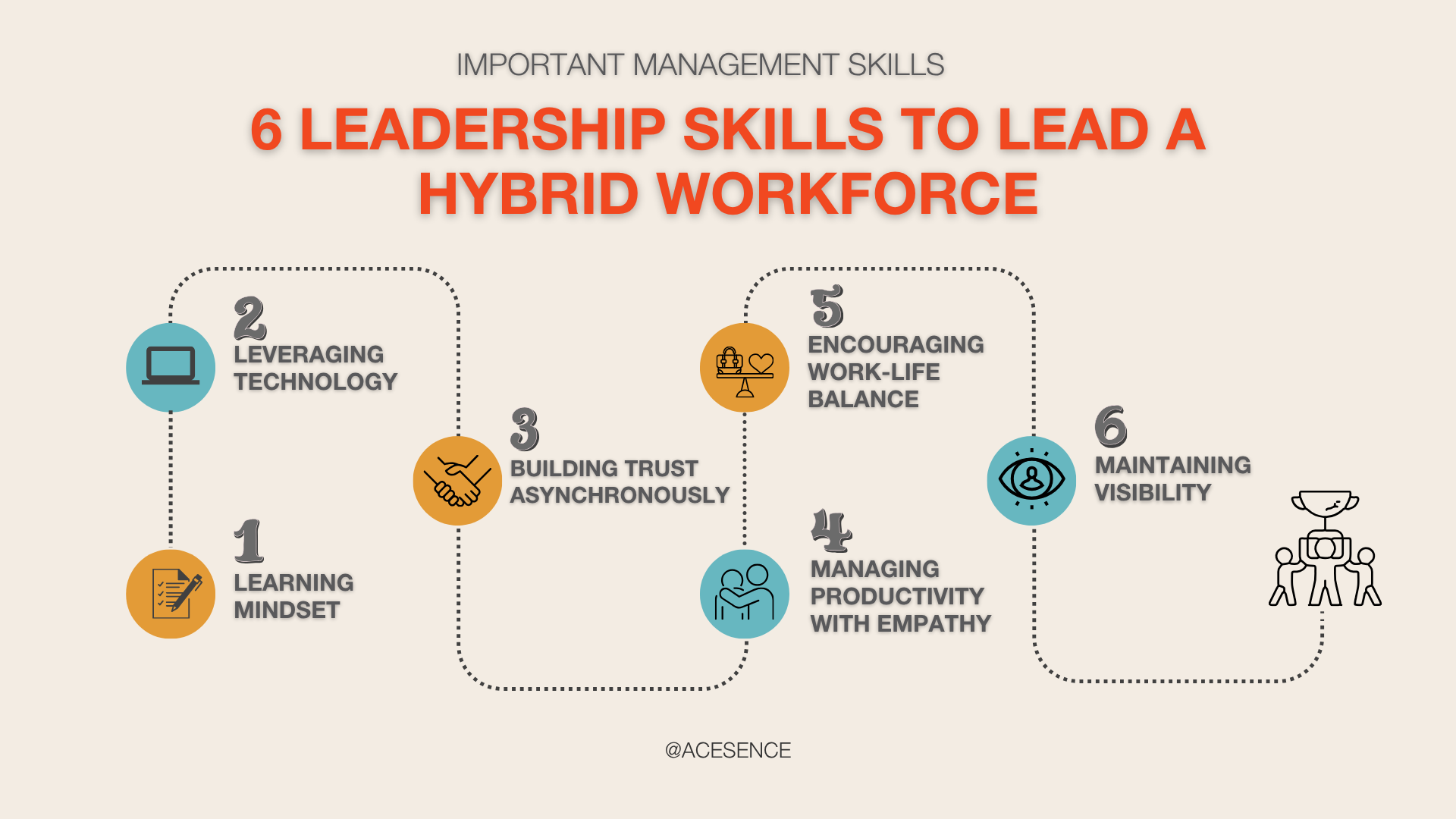
The workplace continues to evolve, and global working has become a long-term reality for many organizations. As teams become more distributed, flexible, and digitally connected, leaders need to continuously adapt to changing workforce expectations and ways of working.
With this in mind, let’s explore how to improve and further develop the vital skills needed to lead a successful global workforce.
What is a Global Workplace?
A global workforce offers many benefits, including access to diverse talent, round-the-clock productivity across time zones, and flexible ways of working. Teams can collaborate across borders and time zones, all thanks to technological advancements. But it also raises new challenges for leaders:
- Do you have the management skills to build trust and rapport smoothly?
- How will you delegate work and coach your team for leadership roles?
- Are you running virtual meetings effectively?
- How do you support team members to keep up with technological changes?
Leaders carry more responsibility than ever to make global teams work seamlessly. Here are the six skills to do it.
1 Adopt a Learning Mindset
Learn continually- there’s always “one more thing” to learn.
—STEVE JOBS
Leading a global workforce means navigating teams with different cultural norms, generational expectations, and professional backgrounds all at once. A learning mindset isn’t just about keeping up with industry trends; it’s about continuously expanding your cultural awareness and unlearning assumptions that may not hold across borders.
Harvard Business Review stated that a learning mindset involves being motivated to increase one’s competence and master something new.
Why a learning mindset matters
Many leaders still argue that work should happen in the office despite overwhelming evidence pointing the other way. Yet multiple surveys show a large gap in opinions. A study by HBR found that 88% of employees would choose a work that offers flexible time and location, while employers want their direct reports to be accessible.
The question is: will you hold on to tradition, or will you embrace new trends, adapt your leadership styles, and grow as a leader in the future workforce? This is where the learning mindset comes in, what some call learning agility, or the agile mindset.
How to check if you have a learning mindset
To know if you have a learning mindset, use the following questions as a guide.
Are you
- Open to embracing new ideas and concepts and seeing them as opportunities rather than threats?
- Actively learning about the cultural norms, communication styles, and workplace expectations of the countries your team members are based in?
- Do you hone your communication skills and your leadership style to meet employee needs?
2 Teach others How to Work, Collaborate, and Leverage Technology
Leaders must understand technology’s role in leadership and global collaboration. Tools like Slack and Zoom create more efficient, communication-friendly work environments. Video conferencing enables meetings with remote team members. BYOD policies give employees freedom to use their own devices. As technology evolves, leaders must keep pace.

Why businesses need to harness technology
Although the era of digital change has arrived, and technology has the potential to increase efficiency and effectiveness, it’s understandable that not everyone is ready to be a champion of change. That’s why, as a global leader, your responsibility isn’t just to adopt technology, but also to ensure that technology works equitably for every team member, regardless of where they are located.
“Leaders have to learn to be good teachers.”
– Harvard Business Review
How leaders can lead in leveraging technology
- Include learning about technological tools in your professional development plan.
- Pair every team member with a learning buddy, so no one has to learn alone. This can help you create a positive work environment.
- Run virtual meetings that actually need to be meetings. Don’t be the leader who drones on to blank screens or holds meetings that could have been an email.
3 Build Trust and Collaboration Asynchronously
Trust is one of the most valuable assets of a healthy workplace culture, and it is easy to lose. Developing leadership skills around trust becomes even more crucial and difficult in global work environments.
Forbes suggests that “The most successful remote organizations are those that can maneuver between asynchronous and synchronous communication.”

Why building trust is more challenging in an asynchronous organization
- You don’t see each other face-to-face to build rapport and trust.
- Cultural differences in communication styles and expectations around directness or formality.
- Increased task-oriented meetings and fewer human connections.
In a global work setup, pay more attention to how communication occurs when the workforce works asynchronously. Leaders also need to be able to support people working across time zones and help their teams navigate those challenges effectively.
One of the most common conflict triggers: misaligned expectations around response times. When teams work across time zones, an unanswered email can quickly become a misunderstanding. Sharpen your skills here and help your team communicate clearly to prevent conflict.
How Leaders Can Lead in Building Trust
- Make clarity of expectations a top priority for your leadership agenda. Everyone must be clear about how they will work together to prevent misunderstandings.
- Make time during work meetings to create positive relationships.
- Address issues early and model how to resolve conflict. Don’t tolerate passive-aggressive behavior.
- Establish healthy communication routines, both online and offline. For instance, email etiquette must be emphasized to foster goodwill and trust.
4 Encourage Work-Life Balance and Promote Mental Health
Work-life balance has never been more critical, yet a Harvard Business Review study on burnout found that 89% of 1500 respondents said their work-life balance was getting worse, affecting managers and employees alike. Gallup confirms that manager stress is at an all-time high.
Why work-life balance is uniquely complex in a global workforce
In a global setup, work-life balance isn’t just a personal challenge; it’s a structural one. When teams span multiple time zones, the boundaries between work and rest blur in ways that don’t happen in traditional office settings:
- The always-on trap. When your morning is someone else’s evening, pressure to respond outside working hours becomes constant.
- Compressed collaboration windows. Shared hours become meeting-heavy, leaving little room for deep work or recovery.
- Varying well-being norms. Attitudes toward rest and mental health differ across cultures. What feels reasonable in one country may feel invasive in another.
Develop leadership at your organization with our globally verified insights to increase team performance. Check out ACESENCE Executive Coaching.
How Leaders Can Encourage Work-Life Balance
- Establish time zone agreements and make core working hours a team norm, not an individual negotiation.
- Rotate off-hours meeting burdens so the same region isn’t always dialing in at midnight.
- Respect international leave and holiday norms without requiring employees to justify time off.
- Model disconnection. Don’t send messages outside your own stated working hours.
For more anti-burnout tips, sign up for our newsletter and get exclusive tips for better mental health. Subscribe here.
5 Manage Productivity and Accountability with Empathy
Managing a global workforce can be challenging, but it’s an opportunity to learn and grow. Effective leaders need to master various communication styles, understand human motivation, manage productivity and accountability, and regularly assess employee satisfaction. Empathy is essential for leaders’ effectiveness.
In a highly cognitive world, leaders might not believe there’s a place for emotions, but the emotional intelligence to do so would go a long way.
Why empathy is one of the most important skills of a leader
When you’re in a leadership role, showing empathy and compassion to your employees helps them trust you.
A leader without empathy is like an engine without a spark plug — it simply won’t engage.
—Rasmus Hougaard, Author of The Mind of the Leader
“Sometimes, it is important for leaders to display vulnerability and share emotions. That’s because, if employees feel more connection to their leaders, they perform at higher standard and act more kindly to their colleagues. “
—Liz Fosslien and Molly West Duffy’s “No Hard Feelings”
Research conducted by Catalyst found that 76% of employees who experienced empathic leaders who showed compassion and understanding reported feeling engaged, compared to just 32% under less empathic leaders.
How Leaders Can Manage Productivity and Accountability with Empathy
- Look out for employees who are struggling to meet deadlines. What can you do to support them and help them succeed?
- Consider how you can help all team members grow professionally or embark on leadership development.
- Include motivational theories in your leadership development.
- Focus on career discussions and develop coaching skills to help them advance their careers and leadership.
6 Maintain Visibility in a Global Setup

While many employees embrace working in distributed global teams, it comes with its unique challenges. Recently, the term proximity bias came into play. According to HRM Asia, proximity bias exists when people place a higher value on work they see or are directly aware of and discount work they do not know about. That’s why, to lead effectively in the global workplace, it is important to help yourself and others maintain visibility.
Why Leadership Visibility is Important
Leadership is about more than just strategy. Understanding the importance of visibility helps eliminate proximity bias. It builds trust and credibility, encourages your team to be more accountable for their work, and helps to keep everyone on track with their goals and responsibilities.
When you’re out of mind, people start to wonder if you are paying attention to what’s happening in their careers, making them less likely to take the initiative on their projects. If you want to retain top talent and keep engagement high must prioritize being seen and present.
An effective leader shows great leadership by being visible to their team.
– Mindtools
- Be visible and accessible to your direct reports so you can accurately assess their performance, motivation, and the support they need from you.
- Create accountability plans that include both on-site and remote employees.
- Include team-building activities in virtual calls. This activity can develop strong relationships, challenge critical thinking, and increase employee engagement.
- Learn to communicate effectively. Speak effectively about your team’s accomplishments so they get the recognition they deserve. Communication skills are among the most important leadership skills.
Did you know that you can improve your communication skills with storytelling?
Check out Leadership Storytelling.
Now that you have learned the 6 effective leadership skills for leading a global workforce, it’s time to evaluate which skills you need to build. Identify your strengths and weaknesses, and prioritize accordingly. Make plans to gain the ability to lead with confidence, from sharpening your decision-making skills to building trust across time zones, and you’ll find leading in the global workplace rewarding and fulfilling.
Frequently Asked Questions
How do leaders build trust with global employees?
Trust across a global workforce requires intentional effort. Set clear expectations on how teams communicate and collaborate, establish healthy online and offline routines, make time for relationship-building, and address conflicts early. Since in-person time is limited and teams span time zones and cultures, consistent, transparent communication is your primary tool for building trust.
How can managers prevent burnout in a global work environment?
Lead by example. Set personal boundaries, demonstrate healthy priorities, and model sustainable work habits. Since 89% of employees report worsening work-life balance (Harvard Business Review), the signal leaders send about well-being matters enormously. Self-awareness around your own habits is the best place to start.
What does managing with empathy look like in a global workplace?
Check in proactively with employees struggling with deadlines, have career development conversations, and hold people accountable in a way that makes them feel supported, not surveilled. Catalyst research shows that 76% of employees with empathetic leaders are more likely to feel engaged, vs. 32% with less empathetic leaders, directly impacting job satisfaction and overall performance.
Ready to Take the Next Step?
Chuen Chuen has supported leaders from nearly 40 countries across industries. These leaders face similar challenges to yours. If you’re looking for 1-to-1 coaching, team training, or a speaker, let’s talk about what your organization needs.